Claude Code Basics Lesson 8 of 46
There's No Single Claude: The Model Lineup

- Inside Claude Code there isn't just one model: you pick one, and the choice shows up in the results and on the bill.
- Moving up the models changes three things at once: how much it understands, how long it takes, how much it costs.
- The tools stay the same for everyone: the engine changes, not the car.
- "The most powerful" doesn't mean "the best for you."
There's a name written there, and it's not a detail
When you open Claude Code, there's a name written somewhere: Haiku, Sonnet, Opus, Fable. It looks like a label, but it's actually the most important choice you make before you start: it's the engine you're bolting onto the car we talked about in the last chapter.
The equipment doesn't change. Permissions, files, commands: identical. What changes is who's doing the thinking.
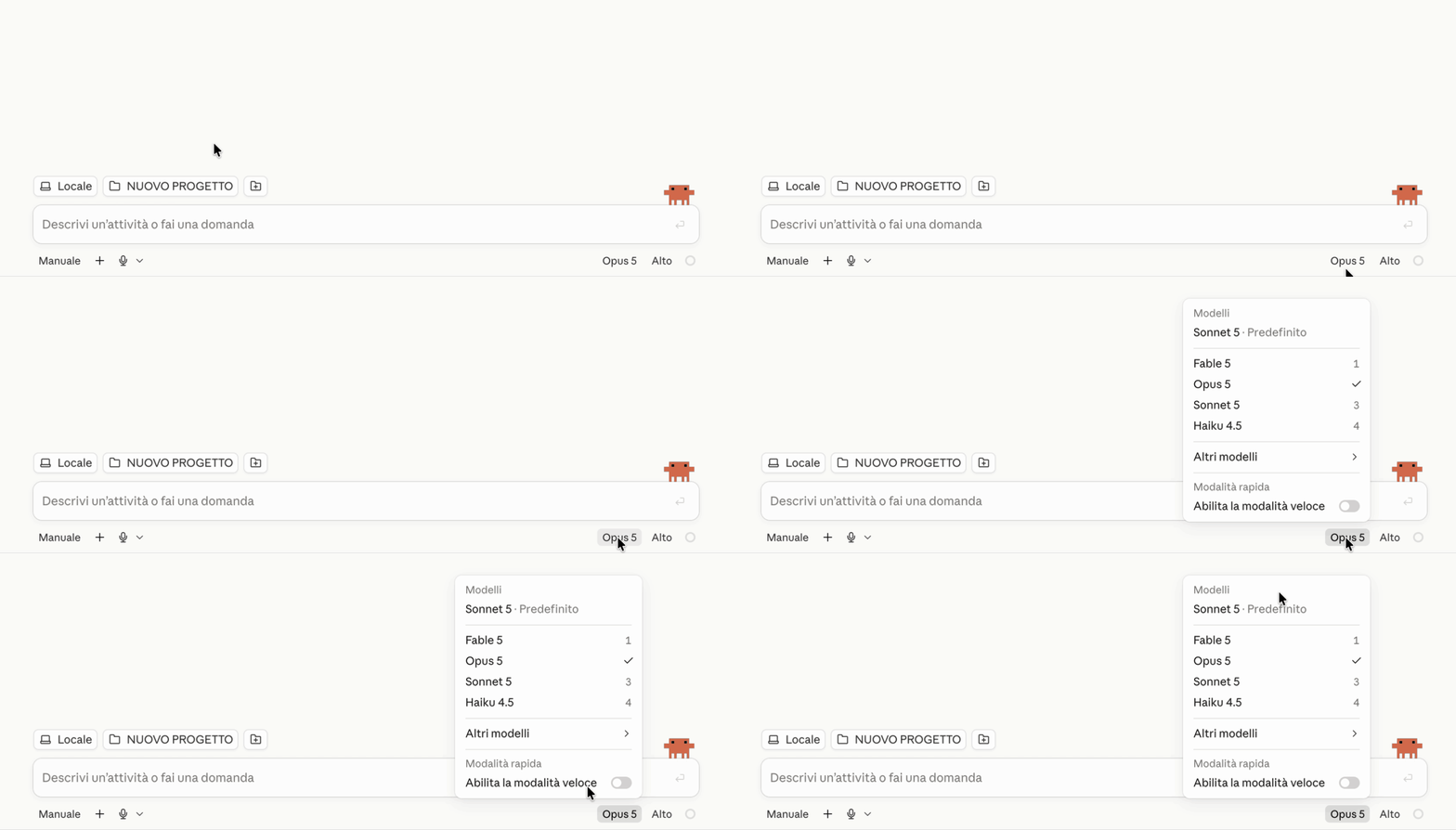
The ladder, from lightest to most capable
They're not four separate boxes: they're a ladder. The higher you go, the more it understands; the higher you go, the longer it takes and the more it costs.
Haiku — the fastest and cheapest. Very close to the others on normal things, less suited when there's a lot of reasoning to do.
Sonnet — the best trade-off between speed and intelligence. It's the workhorse: most days end up here.
Opus — built for complex work, where an agent has to hold a lot of things together at once.
Fable — the most capable one available, built for agents working for a long stretch on demanding tasks. It's also the slowest and the most expensive. In the Premium Landing Page course, it's the one we use.
The trade-off you can't avoid
The temptation, at the start, is one and only one: I'll always set the most powerful one and not worry about it. It doesn't work, and the reason is simple: extra brainpower doesn't turn into quality if there's nothing to figure out.
Renaming two hundred files doesn't call for intelligence: it calls for patience. Done by the most capable model, the result is the same — just slower and more expensive. On the flip side, on a problem with no obvious answer, the lighter model has you going in circles, and in the end you spend more on retries than you would have spent choosing well.
In the next lesson we turn this into a single question to ask yourself before every job.
And now
Knowing there's a ladder isn't enough: you need a way to figure out which rung the job in front of you sits on. In the next lesson there's a single question that settles the choice almost every time.
Did you get it?
Two minutes, no grade. Trying to answer — even getting it wrong — cements the concepts far more than rereading. Not in the mood? Skip it: the lesson still counts as complete.
What changes when you move from a smaller model to a more capable one?
The tools are the same for everyone: the engine changes, not the car. What shifts is three things tied together — capability, speed, and cost — and you can't have all three maxed out at once.
Is the most capable model always the best choice?
On a mechanical task — renaming files, sorting, converting — the more capable model doesn't produce a better result: it produces the same result, more slowly and at a higher price. Extra brainpower doesn't turn into quality if there's nothing to figure out.
 Course Claude Code Basics
 -
Chapter 1 Introduction
-
Chapter 2 What's Underneath
-
Chapter 3 You Choose the Engine
-
Chapter 4 First Time at the Controls
-
Chapter 5 What You Let It Touch
-
Chapter 6 What It Knows About You
-
Chapter 7 Skills
-
Chapter 8 How Many You Put to Work
-
Chapter 9 What It's Connected To
-
Chapter 10 Automating the Setup
-
Chapter 11 Wrap-Up